

The number that gives me hope (Plus the 8% that surprised me)
Hey friend,
Last time, I asked you to ask your kid where they’ve noticed AI this week. Here are some things my kids shared with me over the past week.
My middle schooler told me kids in her grade are using ChatGPT to write texts to each other. And my elementary schooler asked me to “search it up on ChatGPT” when she wanted facts about the anatomy of an eye (yes, her curiosity runs deep).
Those 2 moments opened the door to a real conversation about what AI is good for and what it isn’t, including why asking a chatbot is different from looking something up. I explained that “generative” means it creates new text, which makes it a shaky tool for finding a fact. And even when it sounds completely sure of itself, it can still be wrong.
I’d love to hear yours too. Hit reply anytime.
This week I want to share some research. I promise to keep it to the numbers that actually changed what I do at home, because I know nobody opened this email hoping for a spreadsheet.
Where kids actually meet AI
I think about 5 places a kid might pick up a device. Home. School. Somewhere structured, like a team or a club. Somewhere very unstructured, like somebody else’s basement. And alone, which is where most of the interesting stuff happens.
School is just 1 of those 5. And this fall, in a growing number of districts including New York City and Los Angeles, kids may not be using AI at school at all.
So the other 4? Those belong to whoever is home. (Hi. It’s us.)
What they’re doing there
Common Sense Media surveyed kids ages 9 to 17 this year. Among kids who use AI, 57% have asked it about their health or their body, and 37% have talked with it about feelings or personal problems.
I read that twice. Those are conversations I assumed were still coming to me.
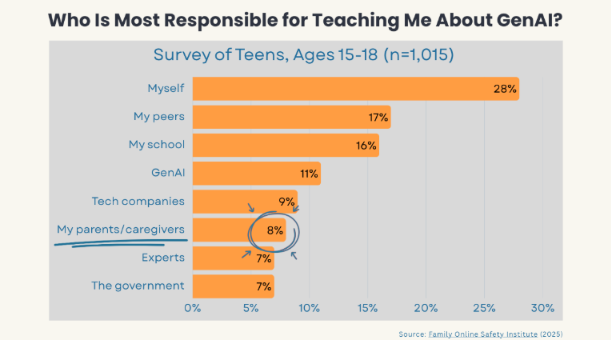
Then the Family Online Safety Institute asked teens who they think is most responsible for teaching them about AI. Parents came in at 8%, which put us behind the chatbot itself.
Before we all take that personally, kids have a pretty good reason for their answer. 44% of them told Common Sense that no parent or guardian has ever talked with them about using AI safely. They looked around, didn’t see an adult raising their hand, and decided this one was on them.
The number that gives me hope
Menlo Ventures found this month that 84% of parents use AI, compared with 56% of non-parents. Parents are some of the heaviest AI users in the country.
We’re just doing it alone at 10pm, planning meals and untangling carpool logistics. (Guilty. Hi again.)
So the capability is already there. What’s missing is the kid sitting next to us while we use it.
Why we hesitate
My friend Nancy Belmont taught me that fear usually shows up in one of 3 ways: fear of not being right, fear of not being liked, and fear of losing control. With AI, I’d bet on the first and the last.
Good news, though. You don’t need to be the expert. You need to be in the conversation.
Start with the scorecard
The PARENT-IN-THE-LOOP™ Jumpstart has a short scorecard that shows you where your family stands right now, with no grades and no judgment. Take it at https://jumpstart.likeamother.ai/ and hit reply to tell me what surprised you. I’m using your feedback to make it better.
Co-Learn, Co-Create & Connect with AI.
Julie | LIKEAMOTHER.AI
P.S. Every source is linked at the bottom of my LinkedIn article: Common Sense Media (2026), FOSI (2025), and Menlo Ventures (2026). AI and kids: parents belong in the sequel
10/19/2026
Be the first to comment